
Thermally conductive plastic – How innovative PlastFormance technology can replace metal
The myth: Thermally conductive plastic is abrasive, expensive, and difficult to process?
The solution to these challenges lies in the right technology!
This article will help you discover how state-of-the-art thermally conductive plastics with electrical insulation deliver the ideal combination of performance, injection moldability, and system cost.

Material requirements for heat sink components
The general trend in electronics is the miniaturization of electronic components and assemblies, coupled with ever-increasing computing power. Power density is rising, making heat generation within the component a limiting factor for its lifespan. This increased heat generation means that thermal management is becoming an increasingly important consideration for designers of assemblies requiring cooling. A thermally conductive plastic is only suitable if the assembly can be efficiently cooled.
Currently, heat sinks are still largely made of metals, such as aluminum. The disadvantage lies in their lack of insulating properties, which necessitates the use of expensive, poorly thermally conductive interface materials for electrical insulation.
A thermally conductive plastic with simultaneous electrical insulation can significantly reduce system complexity. By selecting suitable fillers, thermal conductivity and electrical insulation can be combined in a single thermally conductive plastic. This allows multiple components, such as those of a heat sink, to be integrated into a single part. The innovation of PlastFormance technology lies in achieving extremely high filler concentrations in the thermally conductive plastic while maintaining its injection moldability. The selected isometric particle morphology enables thermal conductivity in all spatial directions.
Material requirements for heat sink components
The main task of a heat sink is to dissipate heat from heat-producing components. For this purpose, the heat flux from the emitter must first reach the heat sink via the entire heat guide path. Both the internal thermal resistance and the heat transfer resistances are adding up in the process. The dissipated heat is finally released through convection to the ambient air. A higher temperature difference between the heat sink and the discharge medium (air, water) is resulting in more efficient heat dissipation.
Consequently, the internal thermal resistance, the heat transfer resistance and the total number of required intermediate layers have a crucial role in the entire assembly. However, component geometry and orientation are also non-negligible parameters in the efficiency of heat sinks.
Heat conduction in electronics
Assemblies
Optimal heat dissipation can be achieved, among other things, by minimizing the number of components in the heat sink. Each component has a specific thermal resistance, which influences the overall heat conduction path (see Figure 1).
Thermal interface materials (TIMs) also negatively impact heat dissipation. As electrical insulators, they typically have very low thermal conductivity and form the bottleneck in the heat transfer path.

Figure 1: Schematic representation of the heat conduction path of an LED heatsink
(based on [1])


Figure 2: PlastFormance heat sink
Materials currently used
Due to its low density and high heat capacity, aluminum is the primary material used in modern heat sinks. Although copper has a higher thermal conductivity, aluminum is used because it is simpler and cheaper to produce.
The heat sinks are usually manufactured using extrusion or aluminum die casting. Both processes have limitations in terms of design freedom. While only linear geometries are possible with extrusion, aluminum die casting precludes undercuts in the castings. The necessary molds for aluminum die casting are expensive and complex to produce. Additional surface treatment is usually required to prevent corrosion. Post-processing methods such as machining, brazing, or welding also increase the overall complexity of component production. [2]
Even though the production chain is well-established in industry despite its drawbacks, lesser-known, optimized materials and manufacturing processes already exist. A thermally conductive plastic can already compete with aluminum through the selection of suitable fillers. Simplified production cycles, the combination of electrically insulating properties and thermal conductivity, as well as increased design freedom in component construction, make a thermally conductive plastic a suitable alternative to aluminum (see Figure 2).

Material requirements for heat sink components
A thermally conductive plastic compound combines the properties of the filler with those of the plastic used. A wide variety of materials are suitable as fillers, such as ceramics or metals. The properties of the filler, for example, excellent thermal conductivity, are "inherited" by the resulting thermally conductive plastic. In this way, for example, a plastic that is both electrically insulating and thermally conductive can be produced.
PlastFormance Technologie in wärmeleitfähigen Kunststoffen
As the filler content increases, the filler-like characteristics of the compound also increase. The problem with conventional compounds is that their processability in injection molding decreases at the same time.
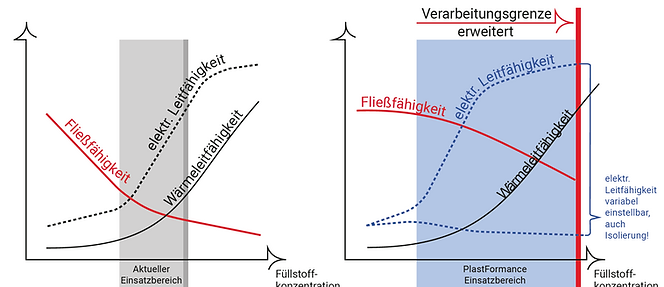
Figure 3: Processability in injection molding at increased filler concentration (based on [3])
PlastFormance technology sets new standards in this area. PlastFormance compounds can contain a filler concentration of up to 80% by volume (see Figure 3) and are still manufacturable using injection molding. This production method allows for greater design freedom than conventional methods for manufacturing aluminum heat sinks.

Figure 4: Uniform heat dissipation through powdered fillers
Another advantage lies in the homogeneous distribution of isotropic fillers. Platelet-shaped fillers, such as hexagonal boron nitride (hBN), align themselves in the direction of flow, resulting in anisotropic heat dissipation (see Figure 4). A thermally conductive plastic from PlastFormance guarantees uniform heat dissipation thanks to the spherical filler morphologies within the material.
Combination of individual component parts
Conventional heat sinks consist of several components to insulate the aluminum component from the electronic product. For example, a thermally conductive plastic eliminates the need for thermal interface materials (TIMs).
By combining thermally conductive and electrically insulating properties, it is possible to attach LED chips, including their conductor tracks, directly onto the thermally conductive plastic produced by injection molding (Figure 5).

Figure 5: Integration of individual components using PlastFormance technology

Figure 6: Course of the contact temperature as a function of the heat sink thermal conductivity (based on [1])
Why thermal conductivity like aluminum is not needed
Typical aluminum alloys for heat sinks achieve thermal conductivities of approximately 140 W/mK. While unfilled plastics have thermal conductivities of 0.2 W/mK, a thermally conductive plastic from PlastFormance ranges between 3 and 15 W/mK.
This may seem technologically disadvantageous, but above a thermal conductivity of approximately 10 W/mK, only slight temperature reductions are observed (cf. [1], see Figure 6). This is partly because the heat sink geometry and convection are insufficient to dissipate the heat efficiently. Furthermore, the electrically insulating thermal interface materials (TIMs) with their very low thermal conductivities (0.5 – 1.5 W/mK) also represent a limiting factor.
Conclusion
The current use of aluminum as a material for heat sinks does not fully exploit its potential in terms of thermal management of electronic components. A thermally conductive plastic based on PlastFormance technology offers a number of advantages that translate into increased heat dissipation efficiency. These include:
Combination of electrical insulation and thermal conductivity in one material
High design freedom thanks to injection molding.
Integration of various components into one component
Simplification of the manufacturing process through the elimination of post-processing procedures
Cost savings in the overall system
Free from corrosion
literature
[1] Heinle, C.: “Simulation-based development of components made of thermally conductive plastics”; TU Erlangen-Nuremberg (2012)
[2] Dietrich, J.: “Practice of Forming Technology”; Springer Verlag (2018)
[3] Griesinger, A.: “Thermal Management in Electronics: Theory and Practice”; Springer Verlag (2019)